
About Hive
What Is Hive Image Organizer?
A private reference library that keeps the working set intact
Most reference tools fail after the save. Hive is built for the stretch where images, links, notes, and source context still need to come back intact on iPhone and iPad.
Most reference tools fail after the save. Material arrives quickly, then gets scattered across screenshots, tabs, chat threads, photo apps, and folders. The image survives. The reason it mattered starts thinning almost immediately.
Hive is built for that stretch in the workflow: the part after discovery, before archive, when a project still needs its images, links, notes, and source context to stay legible long enough to be used again.

How Hive helps once the working set is already moving
It keeps capture, structure, retrieval, and mobile review in one private layer, so the reference does not flatten on the way to real work.
Catch the reference while the source still exists.
Save images, videos, links, and files from Safari, Share, clipboard, drag and drop, or link imports, while the page, thread, or supporting context is still visible.
Let structure arrive after capture, not instead of it.
Use folders, tags, stars, notes, and image comments to keep context attached to each item, so later organization feels like editing the set instead of reconstructing it.
Reopen the right slice without browsing the whole archive.
Use search, filters, and Smart Folders to collapse dense libraries to the exact working set the review, critique, or client conversation still needs.
Keep the project moving on iPhone and iPad.
Use Shortcuts, widgets, slideshow actions, and Eagle Pack import to keep capture, review, and retrieval coherent when the work continues away from the desk.
The break starts after the save
Most people describe reference chaos as an organization problem. It usually starts earlier. A tab closes. A message thread sinks. A vendor page changes. A screenshot lands in the camera roll with no explanation attached. By the time the project needs the material again, the object is still there but the thread that made it trustworthy has already started to disappear.
That is why “saved” is often a false finish line. A reference is only intact if it can still be reopened with enough context to support the next decision.
Most tools drop context right where mobile work needs it most
The first thing most tools lose is not the image. It is the link, caption, note, surrounding page, or reason the save mattered to the project. That loss feels small in the moment and expensive later, because the work has to reconstruct meaning before it can judge anything.
Mobile makes this worse because this is where references first appear: Safari, Messages, Slack, field visits, research, travel, late-night browsing. iPhone becomes intake whether the workflow admits it or not, and iPad becomes the place where active sets are reopened, narrowed, and shown before anyone is back at a desk.

What Hive keeps together
Hive is built so the useful unit is not just the image. It is the reference with its surrounding trail still attached: the source page, the note, the tag, the folder, the shortlist, the project context. That is what makes a save reopenable instead of merely collectible.
The product is private by default because most real reference work is private by default. The material belongs close to the project, not inside a public board or a social feed. It also has to survive mixed-media reality, where a benchmark, material sample, product page, screenshot, and note all need to coexist in one readable place.
- Capture while the page, thread, or source link is still visible.
- Add folders, tags, stars, notes, and comments without flattening the save into a disconnected file.
- Reopen the active set with search, filters, and Smart Folders when review begins.
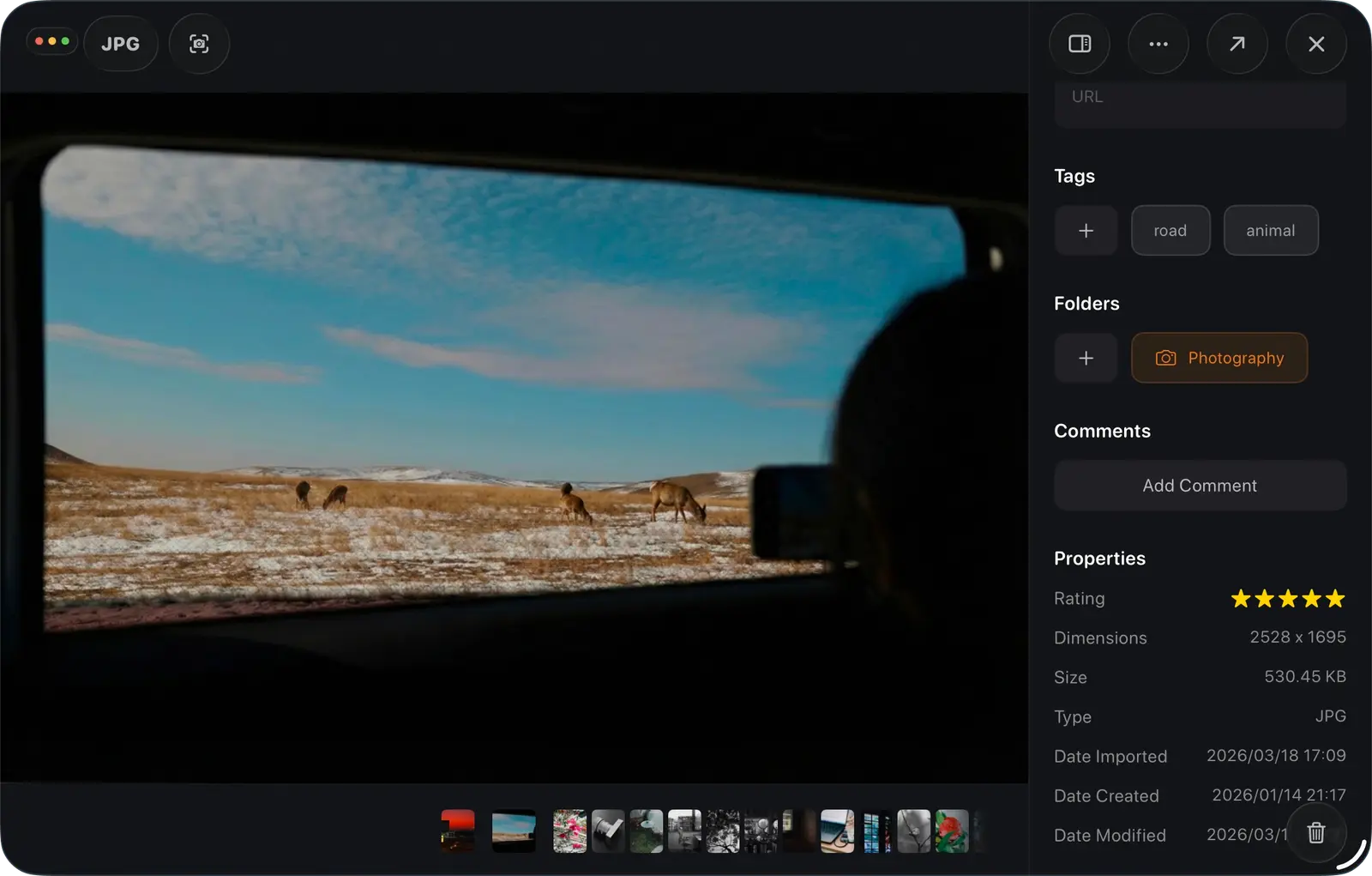
What becomes possible when the working set comes back with meaning intact
Once the save stays legible, later organization gets calmer. You stop doing rescue work before every review. You stop reopening fifteen places to reconstruct why a reference entered the project. You can narrow, compare, reject, and present material that still explains itself.
That changes the feel of the work. Reviews get quieter. Shortlists get easier to defend. The library stops behaving like a pile of saved things and starts behaving like a working surface.
The ambition is fewer forgotten reasons
If Hive works, a project should be able to reopen a material sample, benchmark, or image days later and judge it immediately, without first asking someone in the room to narrate what the software forgot.
The file should not be the only thing that returns. The reason should return with it. That is the standard the product is being built against.
Notes
Is Hive a photo manager?
Not in the generic sense. Hive is built around reference retrieval and project use, not around being a general-purpose photo library.
Is Hive a Pinterest alternative?
Yes, for the private keeping phase. Discovery may start elsewhere, but Hive is built for the part after discovery, when the project needs structure, context, and retrieval.
Does Hive replace Eagle?
No. Hive can fit Eagle-related workflows, especially around mobile capture and iPad review, but it is not trying to be a full desktop archive replacement.
Why build this on iPhone and iPad first?
Because that is where references first appear and where active sets often need to be reviewed, narrowed, and shown before anyone is back at a desk.
Who feels the value most clearly?
People whose work depends on private references staying legible across projects, especially when capture and review happen away from the desk, tend to feel it first.
Related
Who is Hive for?
See which kinds of reference-heavy work tend to feel this problem most strongly.
Save web inspiration
Read the capture-side argument about keeping the source attached from the start.
Reference Manager on iPad
See what happens after capture, when the working set has to come back before review.
Offline, private, and local-first
Read the trust boundary page about privacy, local-first behavior, and how carefully Hive talks about them.